
If there is one thing every parent needs during the day, I’ll bet that quiet, independent play time for their child while Mom and Dad get things done is at the top of the list. But coming up with fresh activities while limiting screen time is easier said than done, though our intentions are good. Read on for some ideas!

Hear me out. We use screen time in our homeschool. Our kids are being raised in an age of technology, and see us using it constantly. Screen time certainly has its benefits when used intentionally and in moderation. When we do use screens, educational content is the focus over entertainment. Websites and apps such as ABCMouse, children’s yoga on YouTube, documentaries, and other educational games that activate the brain rather than relax it are better options. Here’s why: The AAP has shown that excessive media use can have real consequences for kids, including behavioral and emotional development problems. It has adverse effects on sleep, vision, physical and mental health, and social relations. Overstimulation overwhelms self-regulation. So while it may seem easier right now to hand them the phone or tablet, we are likely going to deal with bigger issues later. Preventing screen time habits is easier than breaking them.
With isolation comes great opportunity to connect with our children and maintain the same or better standards for screen usage as they would have in school. Being intentional with the time we have together will only benefit our families, reconnect us to each other in a world of social distancing (it was happening before it happened thanks to social media), and let’s be honest, give teachers everywhere much less headache when school is back in session.
Don’t take this information as a reason to worry, shame, or beat ourselves up. That is absolutely not my intention nor the purpose of this post. We are in desperate times right now, and I’ll be the first to say my kids have had more tablet time this week than usual. My kids watch cartoons for an hour in the mornings while I have coffee and quiet time with the Lord. So please hear me when I say it’s all about striving to do better and keeping perspective. Let’s just say all things with intention and moderation, okay? Cool. Moving on. ❤
A quick word about free play:
Safety first. Independent play does not mean unsupervised play. Have small children do their quiet play in the room where you need to be and keep an eye on them, especially when using small parts or water.
Connect, then go. Little ones need their attention cups filled before they can be expected to play on their own. Start these activities together, then don’t waste time once they have cued they are ready to play alone. Embrace semi-independence where they still can ask questions and you can guide them periodically. They are expected to still have needs even during quiet time.
Let go of any guilt you may have for not being constantly engaged. I’m that way with the mom-guilt, so I assume some others may feel the same at times, and I’m speaking to your mama hearts. Remember we are raising children to eventually become self-sufficient adults. Two key elements of Montessori are self-education and teacher direction. Children are innately curious about their world, and the teacher (parent) encourages them to explore in a carefully prepared learning environment that guides them to make free and intelligent choices for themselves. The teacher is less instructor and more of an enabler. This translates so well to our homes! We can create an environment for learning in a designated corner or room, set up an activity, then respond to our children’s needs, guiding them toward self-study and independence. We don’t have to constantly be in hover mode, instructing, or even initiating at all when they are engaged in independent discovery.
Here are some ideas for setting up a learning environment for independent, quiet play.

Puzzles
One of the simplest activities that already come with all the pieces you need! Children learn spatial awareness, depth perception, perserverance, and so much more! Give them one puzzle to work on at a time, remove all the pieces and lay them out, and instruct them to fit the pieces where they belong. I love seeing their little minds at work as they test each piece, turning and twisting until they get just the right fit.
More ways to play:
- Trace- Have the child trace the puzzle pieces on a piece of paper. They can color in the shapes to match the original piece or let their creativity run wild! Have them practice cutting skills with the shapes, then place them in the puzzle frame to make their own image.
- Mashup- If the same puzzles they do often aren’t entertaining anymore or the child has lost interest, make a puzzle mashup with multiple puzzles at once, pieces mixed together, and have a free-for-all or friendly competition for who can complete them fastest. This one is great for multiple kiddos.
- Hide and Seek- Hide the puzzle pieces and have the child search for them, then assemble. Play with siblings as a team, or compete where each child has to find their own pieces and whoever assembles first wins. You can have them race against the clock if that is a good motivator.
- Blindfolded- Another great one for older kids. Blindfold before assembling and they’ll find out just how difficult those baby puzzles can be!

Animal Sorting
If you are like us, you probably have a plethora of play creatures! Set up a habitat sorting activity like this one. We used a green play silk for the land and a blue play silk for the water, then presented all the animals together in the center. Have the child place each animal in their natural habitat. More ways to play: If you have structures such as coral, trees, etc. they can set up their own little diorama with open-ended pretend play.
More ways to play: You can get creative with all kinds of animal sorting activities. Set up a couple different areas to have your child sort them by the following classifications.
- Habitat- land, water, air
- Attribute – stripes, spots, solids
- Classification- Mammals, Amphibians, Birds, Fish, Reptiles, Insects, etc.
- Pet or Wild animals
- Size / color
- Diet- Carnivore, herbivore, omnivore
- Continent inhabited
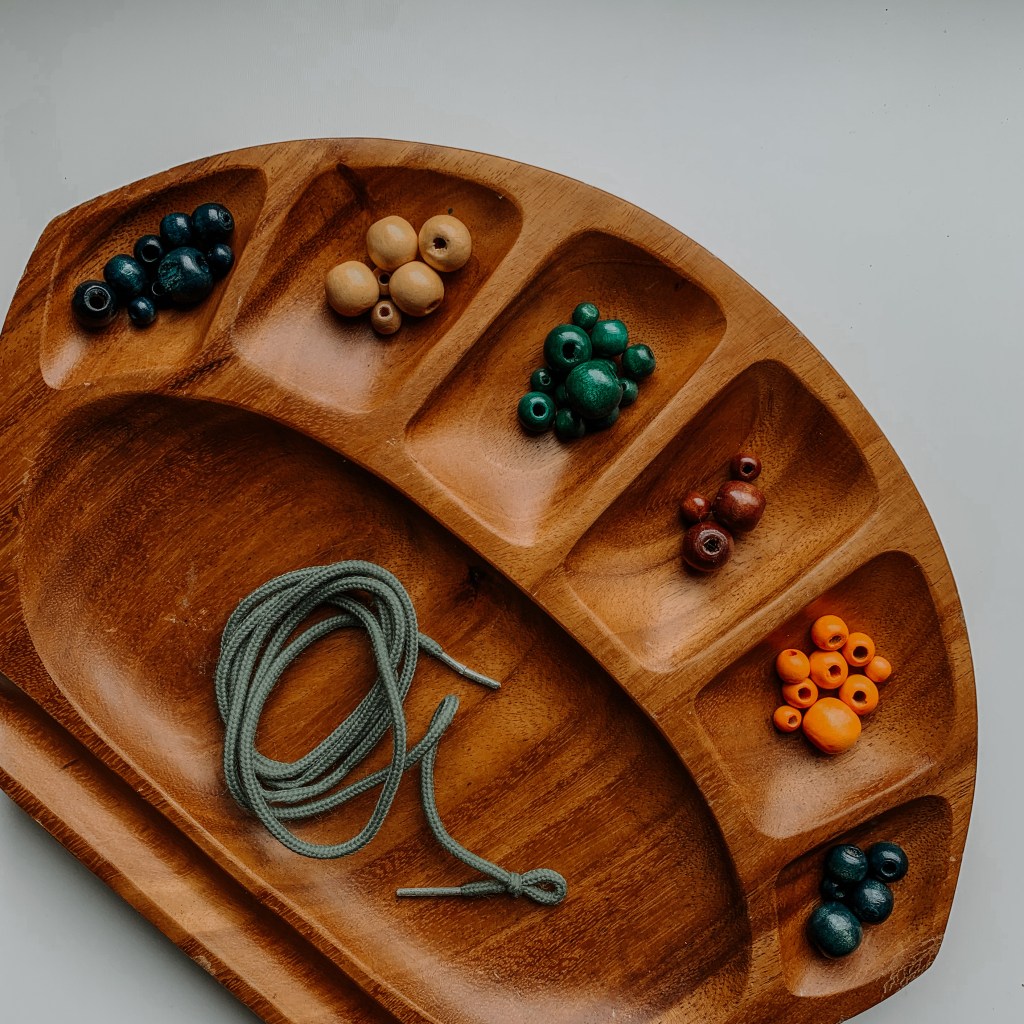
Lacing
It is highly recommended to expose children to activities that strengthen their hands, wrists, and finger muscles. Lacing is a fine motor skill that has both educational and developmental benefits, especially to toddlers. It improves hand-eye coordination, builds pincer grip, increases attention span, and once again- teaches perseverance. Set out some string and beads, cut straws, hole-punched paper plates or cardboard shapes, pipe cleaners in a colander, ribbons or buttons. Keep an eye on small children if using small parts.
More ways to play: Have an older child use the hole- punch and scissors to cut, punch, then color/ paint their own lacing shapes.
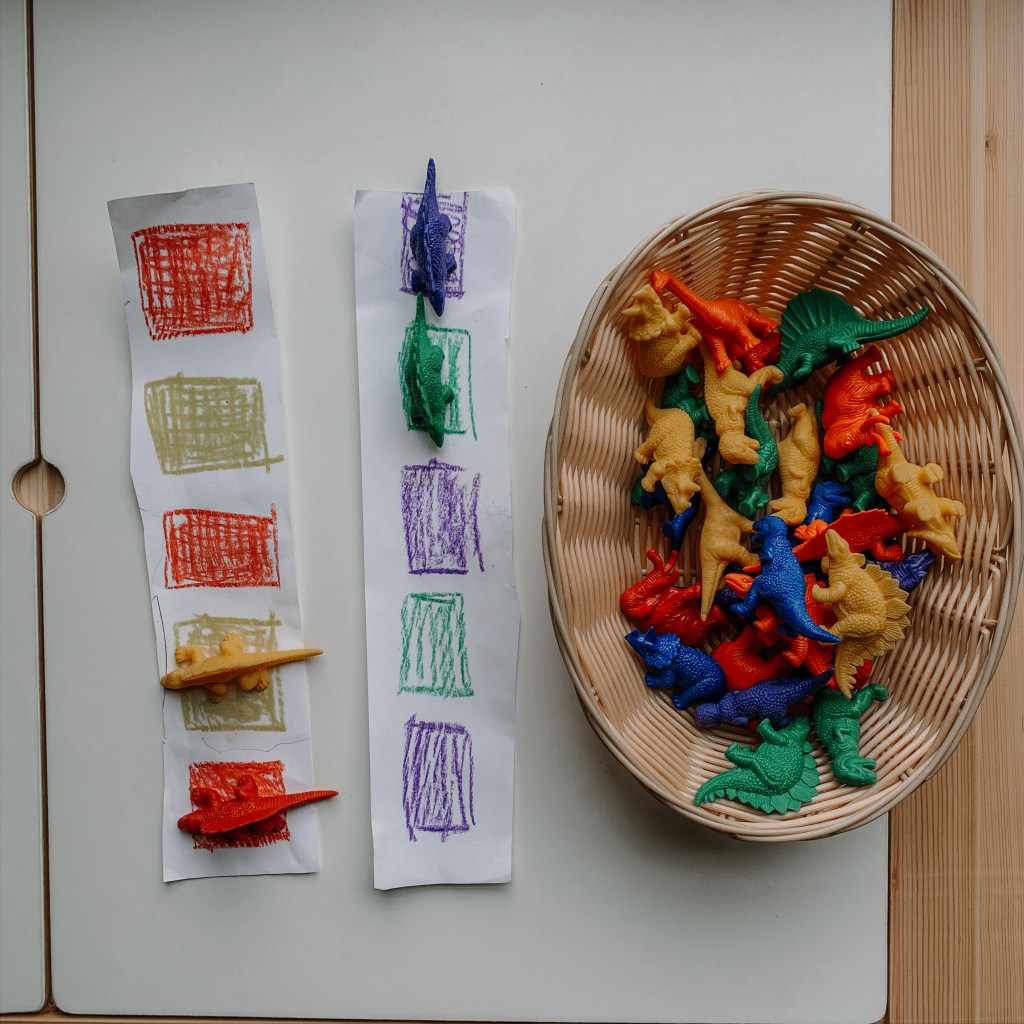
Patterns and Sequences
Creating patterns and putting things in sequential order are all great early math skills. Once children grasp the concept of recognizing patterns and order, they will be better prepared for more complex numbers and mathematical operations. They strengthen problem-solving skills and critical thinking skills which will be applied to other areas of their lives. But equally important, they are fun! I had the kids draw shapes in AB pattern layout, then switch papers and match up dinosaur counters to the patterns. Any counters can be used, but we love these:


More ways to play:
- Start with AB pattern ( i.e. two colors alternating), then do AABB, ABC, AaBb, ABB, and so on.
- Tangrams are great for patterns and shape recognition
- Instead of counters, draw circles on a sheet of blank paper and have them paint, color, use play dough, natural materials (leaf, acorn, leaf, acorn), coins, buttons, poker chips, stamps, beads, stickers, flowers, or even treats to fill them in the designated sequence.
- Create a simple story sequence. Tell your child a simple story, writing key elements on individual post-its or papers. Mix them up and have the child order the story in correct sequence. Instead of a story, use a sequence or routine to reinforce a concept they are already familiar with. i.e.- bedtime routine (jammies, brush teeth, bedtime story, lights off) or a story they know by heart like Noah’s Ark (Ark, animals, rain, rainbow) Stories and number of pieces will vary with developmental capability.
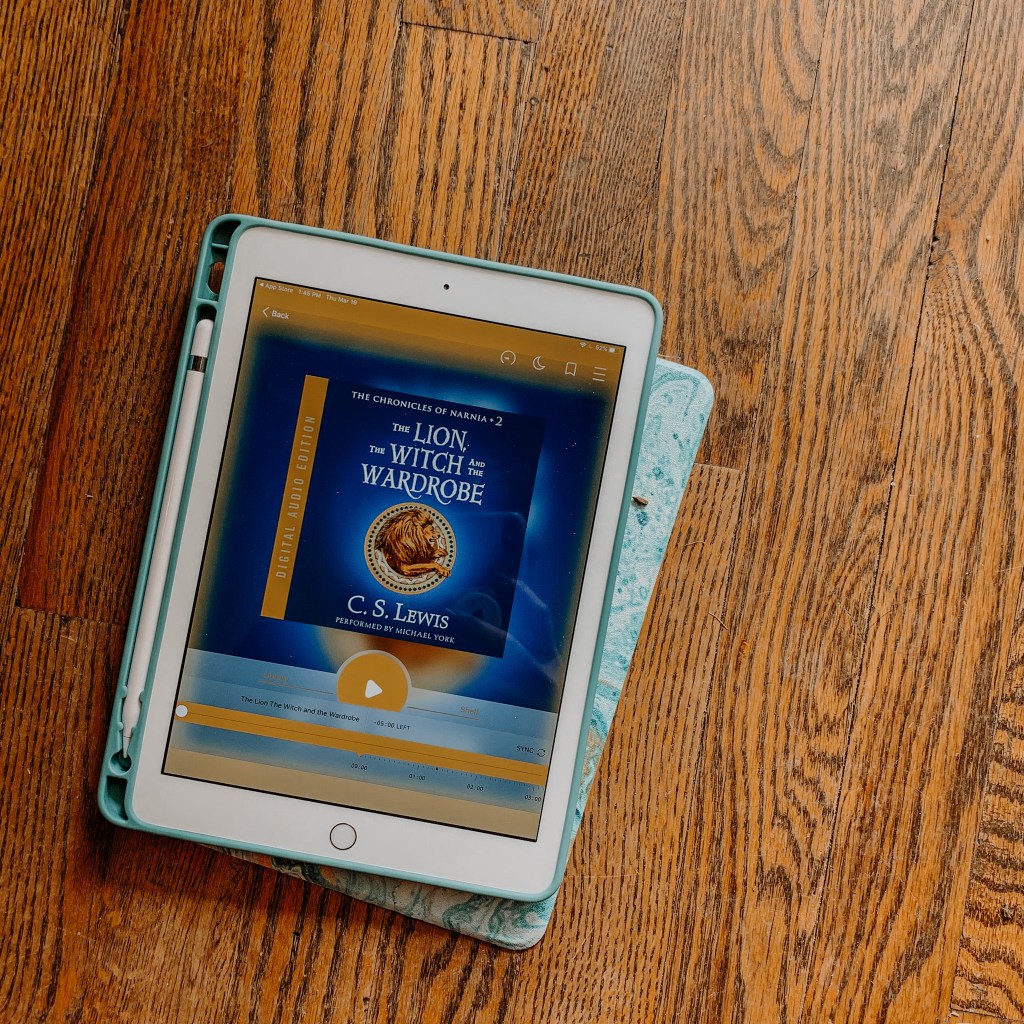
Audiobooks
My kids LOVE read-alouds. It’s why we chose Sonlight with their incredible lineup of living books as our primary homeschool curriculum. They will snuggle up on the couch and listen to me read chapter after chapter of these stories that make the subject come alive in a memorable, emotionally connected story that they will remember for years to come. Charlotte Mason places high value on quality books in education. Reading aloud to our children for 30 minutes each day creates a deep connection to them, as well as inspiring compassion, enhancing early language development, phonemic & print awareness, encouraging family discussions, incite deeper understanding and improving listening skills and attention spans. Kids who love stories love to read. And kids who love to read are well-rounded for future success. Download a “living book” (search the web for the Charlotte Mason- CM- books that qualify) and play it for your child to listen to during quiet time. There are multiple free apps like Libby and Hoopla to get such audiobooks and listen for free. Keep in mind that this is great for quiet time, but not as a substitute for real connection with a parent or caregiver who sits with the child to read a story aloud.
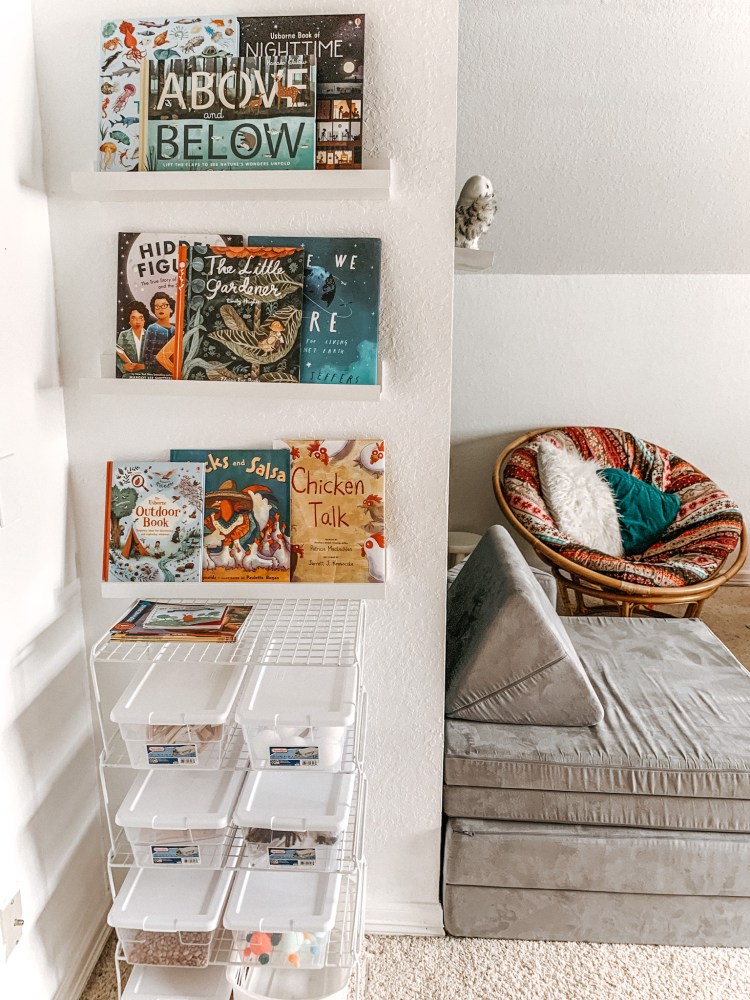
Quiet Bins
Those white-lidded containers are our family’s quiet bins. A simple search on Pinterest can yield an innumerable amount of options for similar busy bags, quiet bins, activity tubs, or what have you. Basically, each container holds one activity for a child to utilize quietly and independently. They are pre-made and rotated often. We rotate about 16 bins and use them to entertain the toddler while I focus on curriculum work with our 1st grader or preschooler. Some of our favorites:
- Pom pom trays- include a pair of child’s tweezers, ice cube tray, and variety of pom pom balls. Have the child pick up pom poms and place them in each cube of the tray. You can also have them sort by colors, size etc.
- Pipe cleaner threading- cut up recycled plastic straws and pipe cleaners
- Sticks in a can- see our previous post here for more on this activity
- Sensory beans- dried beans and various scoops and cups
- Indoor sandbox- right now ours is themed with kinetic sand, dinosaurs, and fossils they have to “dig” for to assemble the Dino bones
- Other bins we have: magnetic fishing, legos, water beads, felt shape scenes, tracing boards from Chalk Full of Design.
- The options are endless! Make these while the littles are asleep and use them only for those times you really need them for 10-30 minutes of quiet playtime.

Printables
Don’t underestimate the power of a free printable. Whether children are working with dot markers, cutting skills, counting, math equations, spelling words, consonant digraphs, or literally anything else, there is a free printable on the web. I print a handful of various activities, plop a bucket of crayons, glue sticks, and all sorts of creating materials, and let them go to work. Some of my favorites are found on the following sites:
- teacherspayteachers.com
- cleverlearner.com
- twistynoodle.com
- schoolsparks.com

Go outside!
I know this may not always be an option, but it’s ALWAYS my first option. Kids love being outside, and there are SO many ways for them to engage in independent play. Make a fairy garden, dig in the dirt, collect interesting nature table pieces, do a backyard scavenger hunt. They will soak up all those delicious moments, vitamin D, and getting fresh air and delicious benefits from the earth. Make sure your yard is kid-friendly and you can see them if you need to. As forest schoolers, we spend most of our days outdoors. We abide in the philosophy that there is no such thing as bad weather, only bad clothing.
I hope this list was beneficial, and inspired some creative ideas in being more intentional with your children during quiet, independent play. Soak up this beautiful opportunity to connect and guide your little learners, watching them flourish in self-discovery and creativity.
 wild folk